
What is ODIN?
The Open Dynamic Interaction Network (ODIN) platform provides a way to use a person's smartphone to ask them questions based on their current location, recent physical activity, ongoing social interactions, and continuous physiological markers. By asking questions about the motivating factors close to the times, places, and contexts of interest, ODIN limits the negative impacts of errors in participant recall. Data collected by ODIN can be used to train models to facilitate intervention planning. For example, personalized forecasting models can use ODIN to deliver just-in-time (JIT) behavioral intervention messages to a subset of participants as part of a clinical trial.
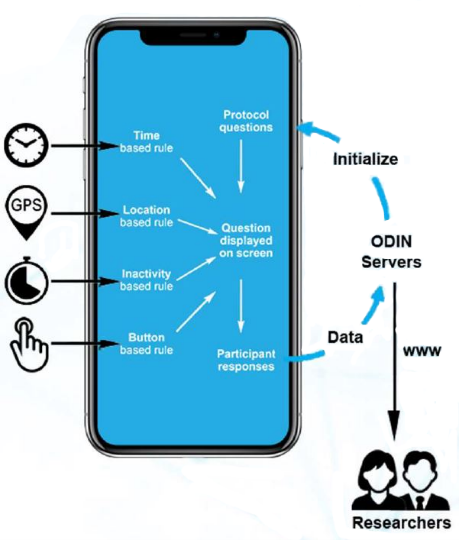
How does one use ODIN?
- Using the ODIN website, researchers specify study questions and the rules governing the contexts in which each question should be asked.
- The website allows the researcher to print coupon QR codes which can be distributed to eligible participants in a rolling recruitment process.
- Each participant downloads ODIN from the Apple/Google store and enters their coupon. ODIN then asks them appropriate questions in each context for the study participation period.
- Researchers can use the website to monitor the study, analyze data, modify the protocol, build forecasting models, and push intervention messages to participants.
What types of questions can be asked?
| Question type | A real-world example of the Questions |
|---|---|
| Multiple choice (single and multi-select) | Which of the following substances did you use yesterday? (1) heroin, (2) meth, (3) cocaine, (4) PCP… Select all that apply. (RDAR study) |
| Free text entry | Enter a journal entry describing any experiences of discrimination you experienced in the past 24 hours (ARDEN study) |
| Likert scale | On a scale of 1 to 10, how strong is your craving to drink right now (CASA study) |
| Psychometric tests | You will see a series of images and will be asked to recall the order and arrangement of images you saw. Press ready to begin (REACT study) |
| Open: new types of questions! |
What types of sensors and contextual rules are supported?
| Sensors | Rules | A real-world example of the Rule |
|---|---|---|
| Time |
|
At 9am and at 5pm every weekday for the first 7 days of participating in the study (RDAR study) |
| GPS |
|
When the participant arrives near one of the 515 bars and alcohol outlets in Lincoln, Nebraska, during each of their hours of business (CASA study) |
| Bluetooth |
|
When three or more student participants who have been located in the same space for more than 20 minutes leave the interaction (MFAFY study) |
| Beacon |
|
When a youth experiencing homelessness leaves a shelter facility (SAC study) |
| Activity |
Some time after a person starts or stops
|
When a person who uses opioids has been stationary (or their phone has been stationary) for more than 12 hours (RDAR study) |
| Open: new sensors! | Open: new rules can be defined |
What does it cost to use the ODIN website?
ODIN's Free Tier enables small-scale pilot studies for platform evaluation purposes. Larger projects require provisioning hardware and support with costs varying based on the scale of deployment.
To access the Free Tier ODIN website follow this link.
| Free Tier | Pilot Tier | Premium Tier | |
|---|---|---|---|
| Max concurrent studies, etc | 2 | 2 | 2 |
| Study scale limits Participants | 10 | 30 | Up to 500 |
| Duration (days) | UNLIMITED | 30 days | Up to 720 days |
| Recruitment (days) | UNLIMITED | 30 days | Up to 365 days |
| Startup cost | FREE | $2200 | – |
| Monthly cost | FREE | $1400/mo x 2 mo |
How can I use the Free ODIN app?
The ODIN app is available via Apple Store or Google Play.
For tutorials on ODIN follow this link.


What other scientific projects used ODIN?
| Study | Target Population | N | Participation |
|---|---|---|---|
| CASA | Individuals with Alcohol Use Disorder in non-hospitalized residential treatment | 60 | 30 days |
| SAC | Youth experiencing homelessness | 150 | 30 days |
| RDAR | Opioid users in the Midwest | 150 | 14 days |
| BROCK | Families in the Midwest | 100 | 60 days |
| CASE4ADHD | Undergraduate students with ADHD diagnosis | 40 | 14 days |
| NAPPER | Undergraduate students who self-identify as binge drinkers | 120 | 90 days |
| REACT | Undergraduate students who drink at bars | 90 | 14 days |
| You | Your population of interest |